

3–4 Years: Growing Communication, Big Feelings & a Bigger World
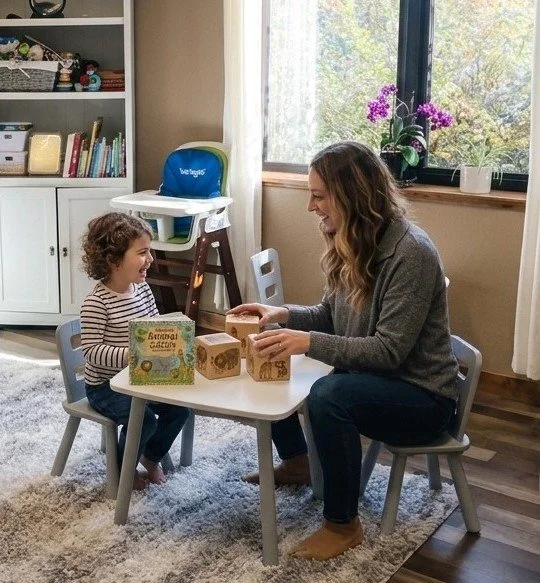
There is something special about the 3 to 4 year stage. Your child may suddenly seem to have an opinion about everything. They have more to say, more questions to ask, bigger ideas, and a growing desire to do things their own way. They my also have very big feelings about things that seem pretty small to the adults around them.
One minute, your child might be explaining an elaborate pretend-play story. The next, they are crying because you cut their sandwich the wrong way, refusing to put on their shoes, or insisting they can do something all by themselves.
Welcome to the preschool years!
This stage brings exciting growth in speech and language, social communication, imagination, and independence. But it is also a time when the brain is working hard to connect all these new abilities. Children are learning to express what they think and feel, understand other people's perspectives, manage frustration, and navigate boundaries. Those skills don't all develop at the same pace.
Let's look at what communication can look like between ages 3 and 4, why some of these behaviors are part of development, and how we can support children as they learn to communicate with the world around them.
Speech and Language Are Becoming More Complex
Between ages 3 and 4, children are moving beyond short phrases and beginning to use language to explain ideas, share experiences, ask questions, and participate in longer conversations.
You might hear sentences such as:
“Mommy, I want to ride bike.”
“Why is dog running fast?”
“We made cookies grandma’s.”
“Look what I made! A big castle.”
Children are also learning to use more grammatical forms, describe what they see, and connect ideas. Their vocabulary continues to grow, and they begin to use language for more than requesting things or labeling what is around them. They are telling stories, sharing opinions, explaining what happened, and trying to understand how things work.
You may notice that your child asks why approximately one hundred times a day. While this can certainly test a parent's patience, those questions are an important part of learning. Children are gathering information, making connections, and using language to organize their understanding of the world.
How can you support this growth?
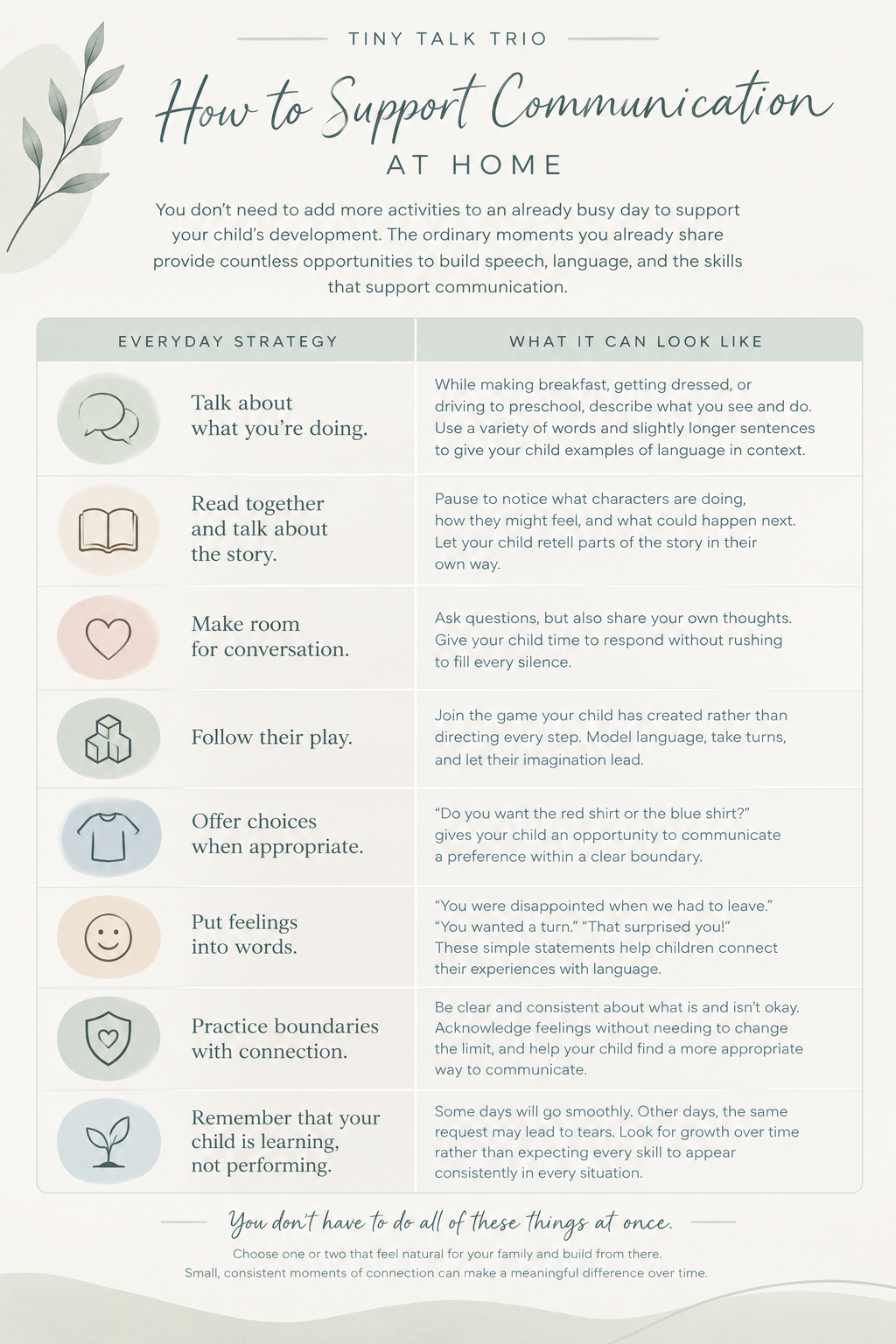
You don't need flashcards or formal lessons. Everyday conversations are full of opportunities.
When your child says, “Dog running,” you might respond, “Yes! The big dog is running across the yard.”
When they tell you, “I went park,” you could say, “You went to the park, and you played on the swings!”
You are giving your child a slightly longer, more complete model without requiring them to repeat it. This helps build language naturally within a meaningful interaction.
Follow their interests, give them time to respond, and remember that communication grows through connection, not constant correction.
Understanding Language Is About More Than Following Directions
As children's expressive language grows, their understanding of language continues to develop, too.
Children between 3 and 4 are learning to understand more complex sentences, answer questions about familiar experiences, follow directions with multiple pieces of information, and understand concepts such as same and different. They are also beginning to understand more about what other people know, think, and feel.
However, understanding language is not simply about whether a child can follow a direction when asked.
Think about the difference between following a familiar direction during a quiet moment and following that same direction when the television is on, a sibling is talking, and your child is deeply involved in building a tower.
The language may be the same, but the demands on the child are very different.
To understand and act on a direction, a child needs to process what was said, hold that information in mind, shift attention away from what they were doing, and organize their next steps. Depending on the situation, they may also need to manage disappointment about stopping a preferred activity.
That is a lot of work for a developing brain!
A few ways to help:
Get your child's attention before giving an important direction.
Keep directions clear and manageable.
Break longer directions into smaller steps when needed.
Allow time for your child to process what you said.
Use visual cues and familiar routines to support understanding.
If your child struggles to follow directions, it can be helpful to look at the whole situation rather than immediately assuming they are not listening. Sometimes the challenge is understanding the language. Other times, attention, memory, distractions, or the transition itself may be contributing.
Speech Sounds: Becoming Easier to Understand
As children's sentences get longer, their speech continues to develop. They are coordinating the movements of their lips, tongue, jaw, and breath to produce increasingly complex combinations of sounds.
By this age, many children are becoming easier for people outside their immediate family to understand. They may still have difficulty with certain sounds, especially those that develop later, and longer words can be more challenging than familiar, shorter words.
You might hear your child say a word differently each time they try it, simplify a longer word, or become frustrated when someone doesn't understand them.
This is where it helps to look at the overall pattern of development rather than focusing on a single sound.
Is your child becoming easier to understand over time? Are they attempting longer words and sentences? Can familiar adults understand most of what they say? Can they communicate their ideas without frequent frustration?
These are useful questions to consider alongside age-appropriate speech sound expectations.
You don't need to correct every sound or ask your child to repeat every word. Instead, model the word naturally in your response. If your child says, “I see a wabbit,” you might say, “You see a rabbit! It's hopping through the grass.”
If your child is frequently difficult to understand, becomes frustrated when communicating, or seems to be making little progress, a speech-language evaluation can help determine whether additional support would be beneficial.
Social Communication, Play and Imagination
Have you noticed your child assigning everyone a role during pretend play? Perhaps they want to be the doctor while you are the patient, or they insist that the couch is a spaceship and everyone must follow their rules.
Play becomes increasingly imaginative during this stage. Children begin creating more elaborate scenarios, acting out familiar experiences, and using language to develop and maintain a shared idea.
Pretend play also creates opportunities to practice social communication.
Children are learning how to:
Take turns talking and playing.
Share ideas and negotiate roles.
Notice how another person responds.
Ask questions and explain their ideas.
Repair misunderstandings.
Adjust what they say depending on the situation.
Of course, these skills are still developing. A child may understand that another person wants a turn but struggle to give up the toy. They may want a friend to follow their pretend-play plan without yet knowing how to negotiate a different idea.
That doesn't mean the social skill is absent. It may mean your child needs more practice using it in the moment.
You can help by joining their play, modeling simple phrases, and gently supporting interactions.
For example:
“You want to be the firefighter, and Sam wants to be the driver. How can we make room for both ideas?”
Or:
“You were telling her about your tower, but she didn't hear you. Let's try saying it again.”
These small interactions help children learn that communication is not just about what I want to say. It is also about listening, responding, and finding ways to connect with other people.
Big Feelings, Boundary-Pushing and the Developing Brain
This is often the part of the preschool years that leaves parents wondering, Why does everything have to be a battle?
Your child may argue about getting dressed, refuse a request they were happy to follow yesterday, insist on doing something independently, or become overwhelmed when plans change.
They may know the rule and still break it. They may understand that hitting hurts and still hit when they are angry. They may ask for help and then become upset when you try to help.
It can feel contradictory, but there is an important piece of development happening here.
Knowing what to do and being able to do it in the moment are two different skills.
During the preschool years, children are developing what are called executive function skills. These include working memory, attention, impulse control, flexible thinking, and the ability to plan and manage actions.
These skills help us pause before acting, shift from one activity to another, remember instructions, and consider what might happen next. They develop over many years, with early childhood providing important opportunities to practice them.
A 3-year-old may understand that they need to put their shoes on before leaving the house. But if they are deeply engaged in play, tired, frustrated, or overwhelmed by the transition, they may struggle to stop, shift gears, and follow through.
The expectation may be reasonable. The ability to manage all the steps independently may still be developing.
This is why boundary-pushing is not always a sign of deliberate defiance. Sometimes it is an expression of growing independence. Sometimes it is curiosity. Sometimes it is frustration, fatigue, or difficulty communicating. And sometimes a child is simply experimenting to find out what happens when they do something differently.
Our job is not to remove every boundary. Children need boundaries, consistency, and adults who help keep them safe. But we can hold those boundaries while recognizing that the skills needed to follow them are still developing.
For example, instead of getting pulled into a lengthy argument about putting toys away, you might say:
“You want to keep playing. It's hard to stop when you're having fun. It's time to clean up now. Do you want to put away the blocks or the cars first?”
You are acknowledging the feeling, maintaining the expectation, and offering a manageable choice.
The boundary remains. The child gets an opportunity to practice decision-making and cooperation.
And when a child is already overwhelmed, fewer words are often more helpful than a long explanation. Once they are calmer, you can talk about what happened and help them consider what they might do next time.
We are not looking for perfect behavior. We are helping children build the skills that make more flexible, independent behavior possible over time.
Why Communication and Emotional Development Are So Connected
Language plays a big role in how children learn to manage their experiences.
Imagine that your child is building a tower, and a sibling knocks it over. Your child may feel angry, disappointed, or hurt. They may not yet have the words to explain what happened or the skills to manage the feeling without yelling, grabbing, or hitting.
As language develops, children gain more ways to communicate those experiences.
They begin to say things like:
“I was still playing!”
“I don't like that.”
“That's not fair!”
“I need help.”
“I want to do it myself.”
These phrases give children more options than reacting physically or becoming overwhelmed without being able to express why.
But here is the important part: having the words does not mean a child can always access them when emotions are running high.
When a child is upset, it can be harder to process language, think flexibly, and choose a response. This is why asking lots of questions, giving long explanations, or expecting a child to talk through a problem in the middle of a meltdown may not be effective.
Start with connection and safety. Use simple language. Help your child settle. Then, when they are ready, you can revisit what happened and model words they might use in the future.
For example: “You were angry when your tower fell. You can tell him, ‘Stop, I was still playing!’ Let's figure out how to rebuild it.”
Over time, these repeated experiences help children connect feelings, language, and actions.
They are learning how to recognize what is happening inside their bodies, communicate their needs, and respond with increasing flexibility. Those abilities grow through practice and supportive relationships, not from a single conversation.
Independence Is Growing, but Children Still Need Support
Three- and four-year-olds often want to do things themselves. They may insist on choosing their clothes, pouring their own drink, opening a package, or completing a task without help.
This desire for independence is an important part of development. Children are building confidence, testing their abilities, and discovering what they can do.
But independence can look messy.
Your child may want to pour the milk but spill it. They may insist they can put on their shoes but become frustrated when they get stuck. They may reject your help and then become upset because the task is harder than expected.
Try to make room for both independence and support.
Instead of immediately stepping in, pause and see what your child can manage. Offer help when needed without taking over the entire task.
You might say:
“You want to do it yourself. I'll wait while you try.”
Or:
“You got one shoe on! The other one is tricky. Would you like a little help?”
These moments give children opportunities to practice persistence, problem-solving, and asking for help.
They also teach an important lesson: needing help does not mean you have failed.
Children don't become independent because we stop supporting them. They become more independent as they practice new skills with the support they need and gradually take on more responsibility.
When Should I Be Concerned About Speech and Language Development?
Every child develops at their own pace, and no single milestone tells the whole story. Still, developmental milestones can help us recognize when a child may benefit from additional support.
Between ages 3 and 4, many children are beginning to:
Use sentences of four or more words.
Talk about something that happened during their day.
Ask and answer simple questions, including who, what, where, and why questions.
Participate in back-and-forth conversations.
Tell others about their ideas, experiences, and interests.
Use speech that is understandable to others much of the time.
Understand and participate in increasingly complex play and social interactions.
You may want to seek guidance if your child is having difficulty understanding everyday language, using sentences to communicate, participating in back-and-forth interactions, or being understood by familiar and unfamiliar listeners. Concerns about hearing, loss of previously acquired skills, or ongoing frustration with communication also deserve attention.
It is important to look at the whole child. Speech and language development can influence play, relationships, learning, and the ability to communicate feelings and needs. At the same time, not every behavioral challenge is caused by a communication difficulty.
A speech-language evaluation can help identify your child's strengths, clarify areas of concern, and determine whether support would be helpful. You do not need to wait until your child is older or until a difficulty becomes more pronounced to ask questions.
The Bigger Picture: Connection Before Correction
The 3-to-4-year stage is about so much more than longer sentences or clearer speech.
Children are learning how to share ideas, understand other people, manage disappointment, navigate relationships, and become more independent. Their brains are building the foundations for skills they will continue developing throughout childhood.
Sometimes that growth looks like a wonderful conversation or an elaborate pretend-play story. Sometimes it looks like saying “NO!” for the fifth time, refusing help, or falling apart over a seemingly insignificant change.
Both can happen in the same child, on the same day.
When we look beyond the behavior, we can begin to ask a different question. Instead of only asking, “How do I get my child to stop doing this?” we can also ask, “What skill is my child working on, and how can I help them practice it?”
That doesn't mean giving in to every demand or expecting parents to respond perfectly every time. It means recognizing that children learn through the relationship between their experiences, their developing brains, and the support they receive from the adults around them.
We can hold boundaries and still be kind. We can support independence while offering help. We can acknowledge big feelings without allowing unsafe behavior. And we can model the communication skills we hope our children will develop.
At Tiny Talk Trio, we believe the whole picture matters. Communication does not develop in isolation, and supporting a child means looking at more than the words they say. It means considering how they understand language, connect with others, navigate their environment, and communicate their needs.
Presence over pressure. Connection before correction. Progress over perfection.
If you have questions about your child's speech, language, or communication development, we are here to help you understand what you are seeing and determine what support, if any, may be beneficial.
Because the goal isn't simply to help children say more words. It's to help them connect, communicate, and grow into their own little people.
A Note About Developmental Milestones
Developmental milestones describe skills that many children demonstrate by a particular age. They are helpful guides, not diagnostic tools or a measure of a child's worth or potential. Children develop at different rates, and individual skills should be considered in the context of overall development. If you have concerns, discussing them with your child's healthcare provider or a speech-language pathologist can help you determine appropriate next steps.
Additional Resources