

The Connection Between Feeding & Speech
If you have a little one who struggles with eating, you may not immediately think about speech and language.
After all, eating and talking seem like two completely different things.
But as a pediatric speech-language pathologist who works with both feeding and communication, I’ve been seeing more and more children who come to my practice with concerns in both areas.
And it often makes parents wonder: “What does eating have to do with talking?”
The answer is: there can be a connection—but it’s more nuanced than you might think.
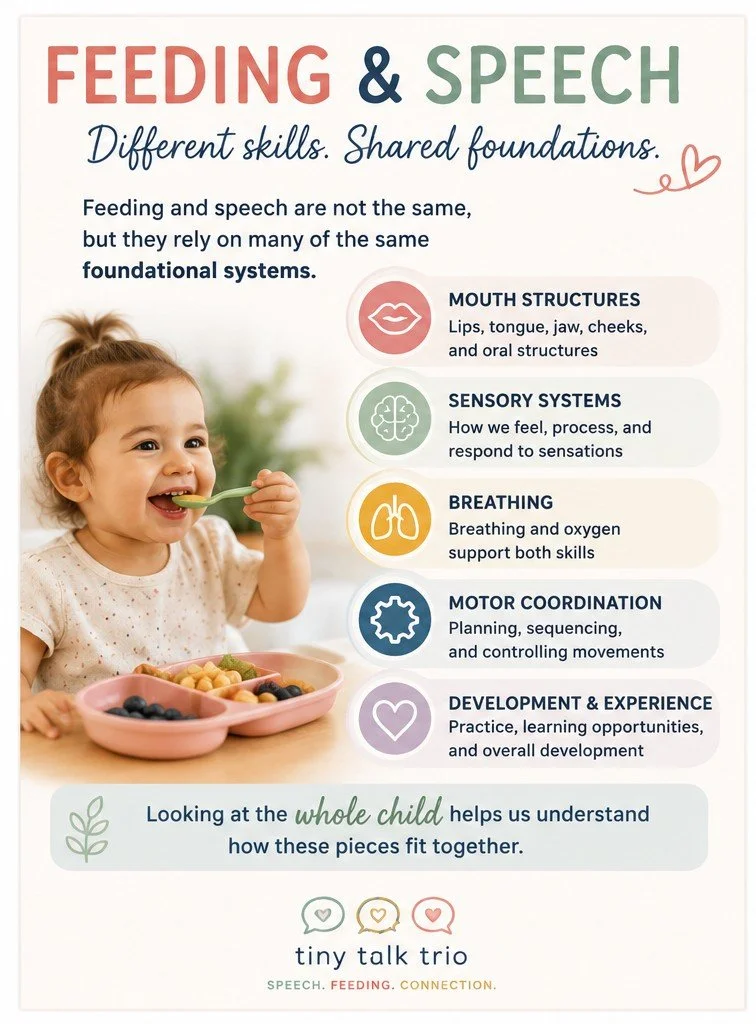
Feeding and speech are different skills. A child with feeding difficulties does not automatically have a speech delay, and a child with a speech delay does not automatically have feeding difficulties. However, these skills do share some foundational systems, and looking at both can sometimes give us a better understanding of the whole child.
Feeding Is Much More Complicated Than It Looks
We often think of eating as something children simply learn to do.
But feeding is actually a complex developmental skill.
A young child has to learn how to:
Coordinate sucking, swallowing, and breathing
Close and control the lips
Move the tongue in different directions
Move food around the mouth
Chew different textures
Manage food and liquids safely
Coordinate the jaw, tongue, lips, and cheeks
Respond to different tastes, smells, temperatures, and textures
Recognize and respond to hunger and fullness cues
According to the American Speech-Language-Hearing Association (ASHA), pediatric feeding involves much more than swallowing. It includes skills such as sucking, chewing, manipulating food in the mouth, and drinking, along with sensory, motor, medical, nutritional, and behavioral factors. So when a child is struggling with feeding, there can be many different reasons why.
And Then There’s Speech...
Speech also requires incredibly precise coordination.
When your child says a word, their brain is planning and coordinating movements of the lips, tongue, jaw, palate, and respiratory system—all within fractions of a second.
Different speech sounds require different movements. For example, /p/, /b/, and /m/ require the lips to come together. Other sounds require very precise tongue placement and movement. This doesn't mean that chewing food is "practice for talking." That's an important distinction.
Feeding and speech are different motor skills. But they can involve some of the same structures and broader motor systems. That's one reason a child's feeding history and oral-motor skills can provide useful information when we're looking at their overall development.
What I Sometimes See in My Practice
A child may come to me because their parents are concerned about:
A very limited food repertoire
Difficulty transitioning to new textures
Gagging with certain foods
Difficulty chewing
Food falling out of the mouth
Pocketing food in the cheeks
Difficulty moving food from one side of the mouth to the other
Difficulty drinking from a cup
Very long or stressful meals
A history of breastfeeding or bottle-feeding difficulties
Significant food refusal
And during the conversation, parents may also mention:
"He's not talking much yet."
"She has words, but nobody can understand her."
"He doesn't imitate sounds."
"She leaves a lot of sounds out of her words."
Sometimes those concerns are completely separate. Sometimes they may be related to a broader developmental, motor, sensory, neurological, or medical picture. And sometimes, we simply don't know until we take a closer look. That's why looking at the whole child rather than putting each concern into its own little box.
Oral-Motor Skills: What Do They Really Tell Us?
This is an area where there is a lot of misinformation online.
You may have heard that a child needs to "strengthen their mouth" to talk or that chewing certain foods will automatically improve speech.
It's not quite that simple.
Speech development isn't just about having strong muscles.
A child needs to learn how to plan, coordinate, and sequence movements for speech. They also need to develop language, understand how sounds work within their language, and learn how to use those sounds to communicate. At the same time, looking at oral-motor function during feeding can give a speech-language pathologist important information.
For example, I may look at:
How a child moves their tongue
Whether they can move food efficiently
How the jaw moves during chewing
Whether the lips provide adequate control
Whether chewing is coordinated
Whether there is a strong preference for chewing on one side
Whether the child has difficulty managing certain textures
Whether sensory differences are affecting feeding
These observations don't tell us that a child will or will not develop a speech disorder. But they can help us understand what may be happening developmentally.
Feeding Difficulties Don't Cause Speech Delays
This is important enough to say again.
A feeding difficulty does not automatically cause a speech delay.
There are many children who are extremely selective eaters and have completely age-appropriate speech and language development. There are also children with speech and language delays who eat a wide variety of foods without difficulty.
However, when both feeding and communication concerns are present, it can be helpful to consider whether there may be a larger underlying factor contributing to both.
For some children, this may involve sensory processing, motor development, neurological differences, structural differences, medical history, developmental differences, or other factors. ASHA recognizes that pediatric feeding and swallowing concerns can involve multiple domains and recommends considering the child's broader medical, developmental, sensory, motor, nutritional, and communication needs.
Your Child Communicates During Mealtimes—Even Without Words
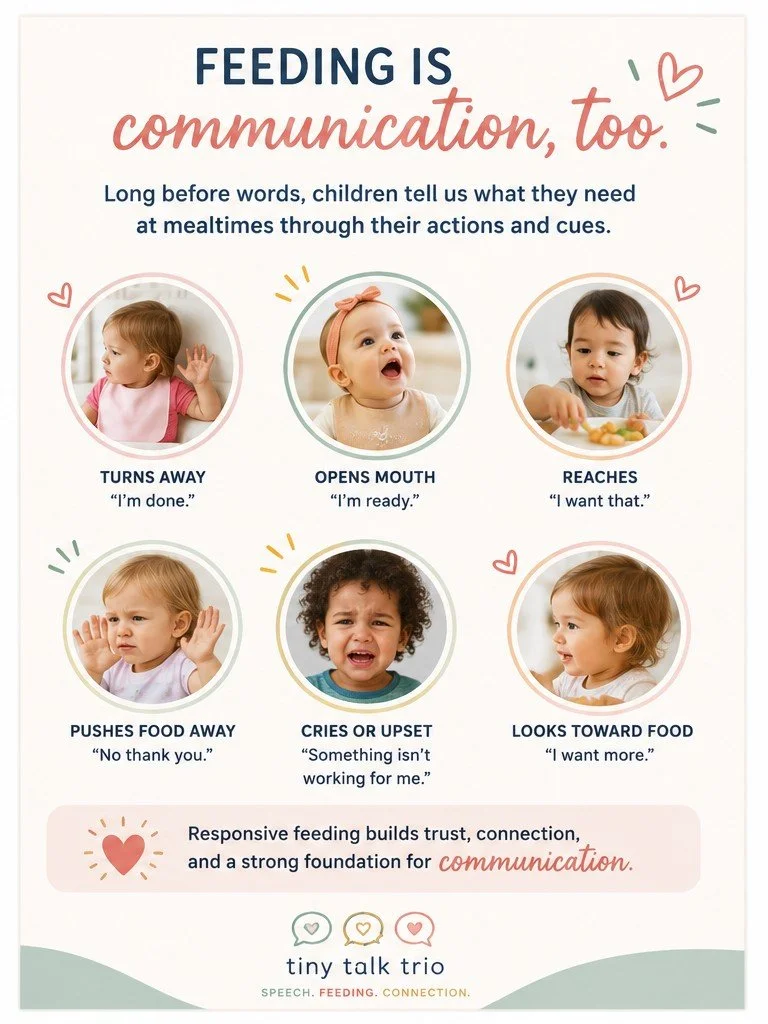
Here's another connection between feeding and communication that I absolutely love talking about with parents: Your child is communicating during meals long before they have words.
Think about all the ways your child tells you what they need:
Turning their head away: "I'm done."
Opening their mouth: "I'm ready."
Reaching for a food: "I want that."
Pushing food away: "No thank you."
Crying or becoming upset: "Something isn't working for me."
Looking toward a food: "I want more."
These are all forms of communication.
ASHA specifically recognizes the communication that happens during feeding and encourages caregivers to recognize and respond to children's feeding cues.
Responsive feeding isn't just about getting your child to eat more.
It's also about helping your child learn that their communication matters.
What If My Child Has Both Feeding and Speech Concerns?
This is where I encourage parents not to panic—but also not to ignore their instincts.
You don't need to wait until your child has a major problem before asking questions.
Consider talking with your pediatrician or seeking an evaluation if you notice several concerns such as:
Feeding
Your child has significant difficulty progressing through textures
Chewing seems difficult or inefficient
Food frequently falls out of their mouth
They regularly pocket food
They gag frequently
Meals consistently take a very long time
Their food repertoire is becoming increasingly restricted
They have difficulty drinking from an age-appropriate cup
Mealtimes have become highly stressful
You notice coughing, choking, or wet/gurgly breathing during or after eating
Communication
Your child isn't meeting expected communication milestones
They aren't using gestures, sounds, or words to communicate as expected
They have difficulty imitating sounds or words
Their speech is difficult to understand for their age
They seem frustrated when trying to communicate
They aren't continuing to gain new communication skills
They lose skills they previously had
ASHA's developmental milestones are designed to help parents understand what to expect across early childhood and when it may be appropriate to seek professional guidance.
The CDC also provides developmental milestone checklists for children from infancy through early childhood.
And remember: milestones are a guide, not a diagnosis. Every child develops differently.
Sometimes Looking at Both Areas Gives Us the Missing Piece
One of the things I love about pediatric speech-language therapy is that development doesn't happen in isolated categories.
A child isn't just a "feeder."
They aren't just a "speech kid."
They are a whole little person.
Their feeding history, communication, sensory experiences, motor development, play skills, medical history, and temperament can all give us pieces of the bigger picture.
Sometimes a feeding concern is a feeding concern. Sometimes a speech concern is a speech concern. And sometimes looking at both helps us recognize something that might have been missed if we only looked at one area.
The goal isn't to find a problem just for the sake of finding one.
The goal is to understand your child.
How do they eat?
How do they communicate?
How do they move?
How do they learn?
What is easy for them?
What is hard?
And most importantly, what do they need to feel successful?
You Don't Have to Wait Until You're Certain
One of the most common things I hear from parents is: "I wasn't sure if this was actually something to be concerned about."
You don't have to know whether something is a "real problem" before asking questions. An evaluation doesn't automatically mean your child needs therapy. Sometimes an evaluation provides reassurance. Sometimes it identifies a small area that can be supported at home. And sometimes it helps us recognize that a child would benefit from additional support.
ASHA encourages parents to seek professional guidance when children are not progressing through developmental milestones, are missing multiple milestones, or lose skills they previously had.
You know your child best. If something doesn't feel quite right, it's okay to ask. And when feeding and communication concerns show up together, taking a step back and looking at the whole child can be incredibly valuable.
A Note From Tiny Talk Trio
At Tiny Talk Trio, we have the opportunity to work with children across both feeding and communication—and one of our favorite parts of this work is helping parents understand why their child may be struggling rather than simply focusing on the behavior we're seeing.
Because behind every "picky eater," every frustrated communicator, and every difficult mealtime is a little person who is still learning.
Sometimes they just need a different approach. Sometimes they need more time and opportunities to practice. And sometimes they need a little extra support.
There is no shame in asking for help. That's what we're here for.
RESOURCES FOR PARENTS
American Speech-Language-Hearing Association (ASHA)
Pediatric Feeding and Swallowing
https://www.asha.org/practice-portal/clinical-topics/pediatric-feeding-and-swallowing/
ASHA Developmental Milestones: Birth to 5 Years
https://www.asha.org/public/developmental-milestones/
ASHA Communication Milestones
https://www.asha.org/public/developmental-milestones/communication-milestones/