

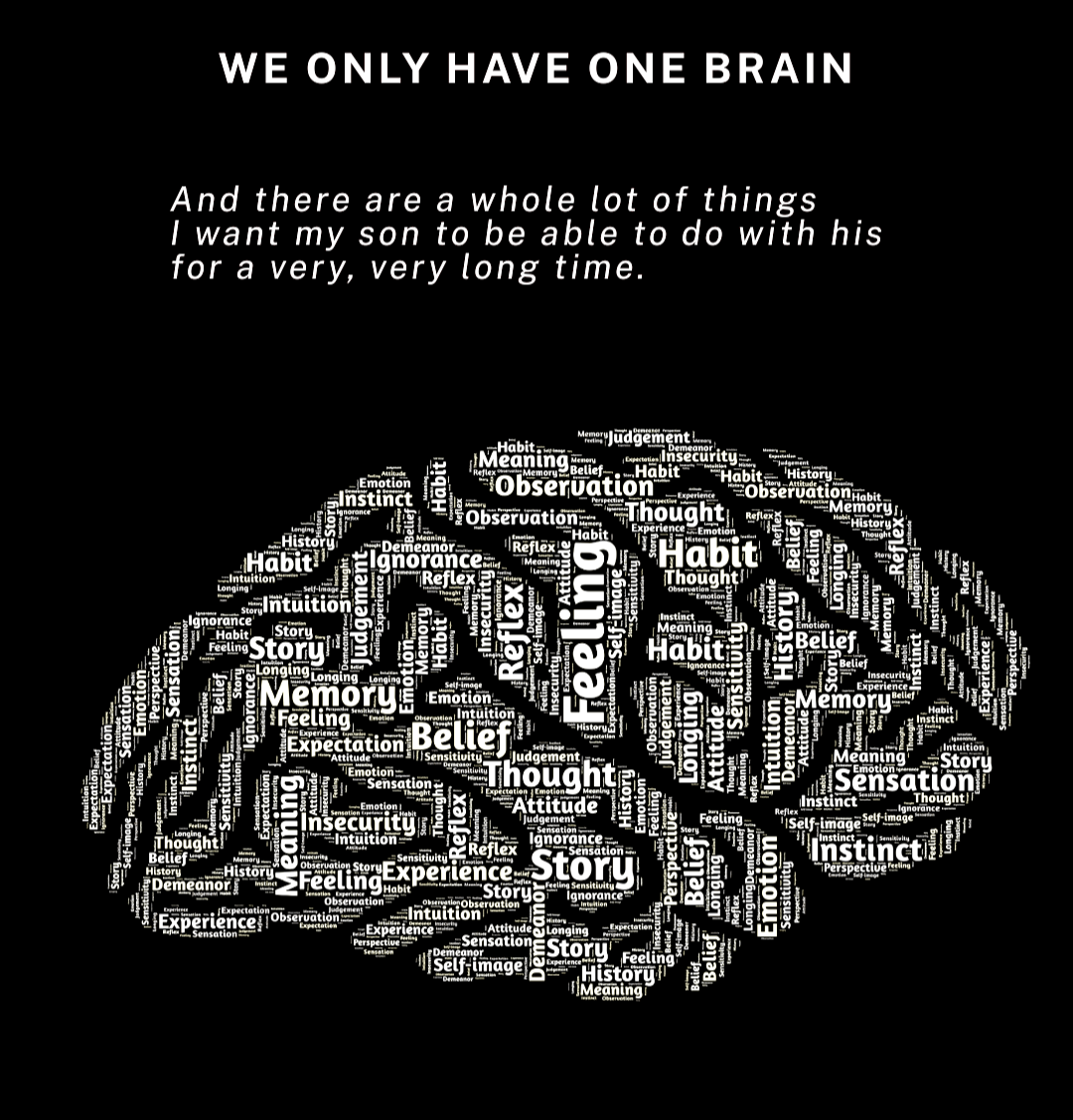
We Only Have One Brain
A Mom’s Reflection on Concussions, Kids & the Sports They Love
This is a little different from what I typically write about here.
Most of what I share is related to speech, language, feeding, lactation, and the development of little brains and bodies. But sometimes something hits close enough to home that it changes the way you think about your work, your children, and the things you thought you understood.
A couple of weeks ago, my teenage son suffered a concussion during football practice.
I have always enjoyed watching football. At the same time, I was hesitant when my own son wanted to play.
I know that concussions are not unique to football. They can happen in soccer, hockey, basketball, gymnastics, mountain biking, skateboarding, skiing, and even in places you would never expect. I know this because I have had concussions myself.
In fourth grade, I was spinning around in the gym, fell, and hit my head. My vision was blurred for hours.
Years later, I went over my handlebars while mountain biking and hit my chin on a rock. After being evaluated by a doctor, and with a deep gash in my chin being held together by glue, I went home and slept for hours because my head hurt so badly.
At the time, I didn't think much about what those injuries might mean years later. We simply didn't know as much as we do now.
But football was different for me.
It wasn't one hit that concerned me as much as the possibility of repeated head injuries. When my son decided to play, I supported him—but I did so with reservations. I told him that if he sustained a concussion, I would not want him to continue playing.
That was my boundary.
And then, before the season had even really gotten started this year, he sustained a concussion.
Less than a week later, his symptoms changed enough that he needed additional medical evaluation and a CT scan. Thankfully, there was no internal bleeding. There were, however, findings that required continued medical attention, and he was not passing portions of his cranial nerve examination.
Then last night, he hit his head again while working in the garage.
Another trip to the emergency room.
Another reminder that the brain doesn't get a reset button.
He will be starting concussion-specific physical therapy, and his rehabilitation plan is still being developed. As his mom, it is difficult to watch your child go through something that you cannot simply fix for him.
And he is no longer playing football.
That decision isn't about demonizing football. It isn't about saying that no child should play contact sports. And it certainly isn't about telling other families what they should choose for their children.
It is about our family making a decision based on what we know about our son, his injuries, and what matters most to him.
Because my son is so much more than a football player.
He loves playing his bass—both acoustic and electric. He loves working on cars and fixing motorbikes. He loves singing in choir. He loves skateboarding around the neighborhood listening to 90s rock and metal, spending time with his friends, and talking to anyone who happens to have an old or interesting vehicle parked in our neighborhood.
Those are the things I think about when I think about his future.
Those are the things that could potentially be affected by another significant head injury or repeated injuries.
He is young. He is tall, strong, fast, and built in many ways for football. And that can make it easy to think, Of course he should play.
But being physically capable of doing something doesn't necessarily mean it is the right choice for you.
That is something I want my son to understand—not just about football, but about life.
When I was a teenager, I played sports without really thinking about what repeated injuries might mean years later. We simply didn't have the information we have today about concussions and the potential long-term effects of repeated head trauma.
Our kids have access to more information now.
I don't want to use that information to scare my son away from everything he loves. I don't want him to stop skateboarding, working on cars, riding bikes, playing music, or being a teenager because I am afraid something might happen.
I also don't want him to do something simply because he thinks he should.
He is almost 6'2". People notice that. Coaches notice that. Other kids notice that. When you're a big, athletic kid, it can be easy to feel like there are certain things you're supposed to do because you're built for them.
But I want my son to learn that his body is his own.
I want him to have enough information to understand both the risks and the rewards of the activities he chooses. I want him to ask questions. I want him to recognize when something doesn't feel right. I want him to understand that walking away from something isn't necessarily quitting—it can sometimes be a very strong decision, but it can also be scary to talk with an adult who has been a mentor and coach.
And I want him to know that protecting his brain is not something to be embarrassed about.
What We Know—and What We're Still Learning
I also want to be careful about how we talk about concussions and conditions such as chronic traumatic encephalopathy, or CTE.
A concussion is a traumatic brain injury. Symptoms can affect how a child thinks, learns, feels, behaves, sleeps, and functions physically. Symptoms don't always appear immediately, and they can change over the course of recovery.
We also know that recovery isn't always predictable. Most children can begin returning to school within a day or two, with adjustments based on symptoms, and return to sports should happen gradually under the direction of a healthcare provider.
Research into repeated head impacts and long-term brain health is continuing to evolve.
A 2025 NIH-funded study found evidence of early and lasting brain changes associated with repeated head impacts in young and middle-aged athletes. The researchers emphasized that these changes may occur years before the characteristic pathology associated with CTE develops.
But there is an important distinction here:
Having a concussion does not mean that someone will develop CTE.
CTE is currently a neuropathological diagnosis, meaning it can only be definitively identified by examining brain tissue after death. Researchers are still working to understand how repetitive head impacts relate to CTE, who may be at greater risk, and what factors influence long-term outcomes.
That uncertainty doesn't mean we should ignore the research. It means we should keep learning. And it means we should take concussions seriously.
The current approach to concussion management isn't simply “sit in a dark room until you're better.” Current guidance supports a short period of relative rest followed by a gradual return to everyday activities, with individualized rehabilitation when symptoms persist. For athletes experiencing problems such as dizziness, headaches, neck pain, or balance difficulties, targeted rehabilitation may be appropriate.
For me, the biggest takeaway is simple: Our kids deserve information.
They deserve to know what a concussion is.
They deserve to know that symptoms can change.
They deserve to know that telling an adult about symptoms isn't weakness.
And they deserve adults who will listen when they say something doesn't feel right.
A Note About This Post
This post reflects my personal experience as a parent and speech-language pathologist. It is not intended to provide medical advice or to make recommendations about whether a child should participate in a particular sport or activity.
Concussions and recovery can look different for every person. Decisions about evaluation, treatment, return to school, return to activity, and return to sports should be made with the child's healthcare team.
My hope in sharing our experience is simply to encourage more conversations about brain health and to remind parents and kids that it is okay to ask questions, speak up about symptoms, and make thoughtful decisions about the activities they love.
As a speech language pathologist, I spend my days helping children develop and use their brains in the best ways possible. We work on communication, learning, feeding, problem-solving, regulation, motor planning, and all of the incredibly complex things the brain allows us to do.
The brain is remarkable.
It is also incredibly important.
We only have one.
So this isn't a post telling families what sports their children should or shouldn't play. It isn't an argument against football. It is simply one mom's reminder to pause and think about the bigger picture.
Learn about concussions.
Take symptoms seriously.
Give kids the information they need to participate in decisions about their own bodies as they get older.
And remember that our children are so much more than the activities they participate in.
For us, right now, protecting my son's brain means stepping away from football and giving him the opportunity to heal.
And honestly?
I am relieved that he chose that path.
Because there are a whole lot of things I want him to be able to do with that brain for a very, very long time.
Sources & Further Reading
CDC HEADS UP — Concussion Basics and Recovery
The CDC provides parent-friendly information about recognizing concussion symptoms, recovery, returning to school, and returning to sports.
CDC — Clinical Guidance for Pediatric Mild Traumatic Brain Injury
Current clinical guidance for healthcare providers caring for children with mild traumatic brain injury, including recommendations regarding imaging, symptom monitoring, and gradual return to activities.
Patricios et al. — 6th International Conference on Concussion in Sport, Amsterdam 2022
The international consensus statement provides evidence-informed recommendations for concussion assessment, rehabilitation, return to school and sport, and discussion of the ongoing questions surrounding repetitive head impacts and long-term brain health.
NIH — Repeated Head Impacts Cause Early Neuron Loss and Inflammation in Young Athletes (2025)
A recent NIH-funded study examining brain changes associated with repetitive head impacts in young and middle-aged athletes.
Ingram et al. — The Incidence of Sports-Related Concussion in Children and Adolescents (2025)
A systematic review and meta-analysis examining concussion incidence across youth sports.
Bishay et al. — Return-to-Learn Following Sport-Related Concussion (2025)
A systematic review examining return-to-learn following sport-related concussion and factors associated with longer recovery.