

When the Latch Looks Good but Milk Transfer Isn’t
Why breastfeeding can appear normal while milk removal is still inefficient
Many parents are told that if the latch looks good and breastfeeding doesn’t hurt, everything must be going well.
And often, that guidance is helpful. A comfortable latch is an important part of breastfeeding.
But latch is only one part of the picture.
Sometimes a baby can latch well and breastfeeding may appear normal on the surface, yet milk is not being removed as efficiently as expected. When this happens, babies may work harder during feeds, feed more frequently, or spend longer at the breast.
Understanding the difference between latch and milk transfer can help parents recognize when feeding may need a closer look.
Latch vs. Milk Transfer
Latch refers to how a baby attaches to the breast.
Milk transfer refers to how effectively milk is removed during feeding.
A latch may appear deep and comfortable, but effective feeding also depends on how the baby’s tongue, jaw, and suction work together while nursing.
When these movements are well coordinated, babies are able to remove milk efficiently and feeding often feels rhythmic and steady.
But sometimes feeding mechanics are working harder behind the scenes.
Understanding the Difference: Compression Sucking vs. Peristaltic Sucking
Babies are biologically designed to use a coordinated sucking pattern that combines tongue movement, suction, and jaw rhythm to draw milk from the breast.
This movement is often described as peristaltic sucking, where the tongue moves in a smooth, wave-like motion from front to back while maintaining suction on the breast. This wave motion helps draw milk from the milk ducts while the baby maintains a stable seal at the breast.
However, some babies rely more heavily on compression to remove milk.
In a compression-based suck, the baby presses the nipple between the tongue and the roof of the mouth to express milk rather than drawing milk primarily through suction and coordinated tongue movement.
Both patterns can result in milk intake, especially when milk flow is strong. But they can feel very different during feeding and may influence how efficiently milk is removed over time.
What Parents and Professionals May Notice
Below is a comparison of these two feeding patterns.
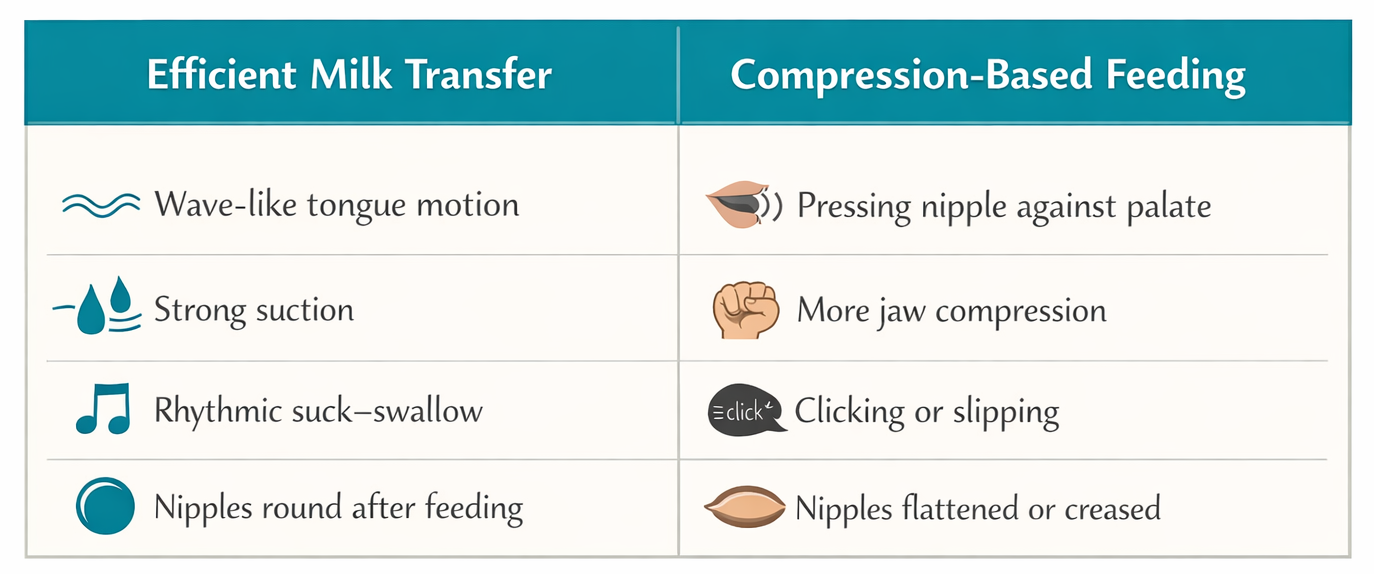
Why This Difference Matters
Many babies use a combination of both patterns, especially while they are learning to feed.
But when compression becomes the primary strategy for milk removal, babies often have to work harder during feeds.
Parents may notice longer feeding sessions, frequent feeding, or babies who seem to tire more easily at the breast.
In the early weeks of breastfeeding, these differences can sometimes go unnoticed because milk flow is often faster while supply is being established. When milk is readily available, babies may be able to compensate for less efficient mechanics.
As milk supply begins to regulate and milk flow becomes more dependent on effective milk removal, these feeding patterns may become more noticeable.
Signs Your Baby May Be Working Harder During Feeds
Because babies are adaptable, the signs of inefficient milk transfer can sometimes be subtle.
Parents may notice patterns such as:
Very long feeding sessions
Frequent feeding with baby still seeming hungry
Baby tiring quickly during feeds
Clicking sounds while nursing
Milk leaking from the corners of the mouth
Baby slipping off the breast
Nipples appearing flattened or creased after feeds
Feeding sessions that feel inconsistent from day to day
None of these signs alone necessarily mean that something is wrong. However, when several of these patterns occur together, it may be helpful to take a closer look at how feeding is working.
Why These Challenges Are Often Missed
Babies are incredibly adaptable.
Many babies compensate by feeding more frequently or staying at the breast longer. These strategies can still allow them to receive enough milk, particularly when milk supply is strong in the early weeks.
Because of this, breastfeeding may appear to be going well even when a baby is working harder than expected.
As milk supply begins to regulate and milk flow becomes more closely tied to effective milk removal, these feeding patterns may become easier to recognize.
A Different Way to Think About Breastfeeding
Breastfeeding is often discussed primarily in terms of milk supply.
But milk supply and milk transfer are closely connected.
When babies remove milk efficiently, the body receives strong signals to continue producing milk. When milk removal is less effective, those signals may gradually change.
Understanding how babies feed helps shift the conversation away from the idea that breastfeeding challenges are always caused by low milk supply.
Sometimes the answer lies in supporting how the baby feeds, not just how milk is produced.
Because breastfeeding is not just about milk production.
A Helpful Shift in Perspective
For many parents, realizing that feeding challenges may relate to milk transfer rather than milk production can bring a sense of relief.
Instead of focusing only on increasing supply, the focus can shift toward supporting the baby’s feeding skills and improving the overall breastfeeding relationship.
When milk is removed more efficiently, the body often responds by maintaining or increasing milk production.
Sometimes the missing piece in breastfeeding is not supply—it is how milk is being transferred.
Up Next in the Series
In the next article, we’ll explore a topic that surprises many parents:
Why fast milk flow or oversupply can sometimes hide feeding challenges early on.
Some babies appear to breastfeed easily in the beginning because milk flows quickly, but when supply begins to regulate, feeding difficulties may become more noticeable.
Part of the Series: The Other Side of Milk Supply
✔ Breastfeeding Is a Two-Person System
✔ When the Latch Looks Good but Milk Transfer Isn’t
⬜ The Hidden Feeding Patterns That Reduce Milk Supply
⬜ Why Fast Milk Flow Can Hide Feeding Challenges
⬜ Signs Your Baby May Be Affecting Milk Supply
⬜ How Improving Feeding Mechanics Can Support Supply