

Why Fast Milk Flow Can Hide Feeding Challenges
When breastfeeding seems easy at first, but difficulties appear later
Some mothers describe the early weeks of breastfeeding as surprisingly smooth. Their baby latches quickly, feeds often, and milk seems to flow easily.
Then, weeks later, something changes. Feedings become longer. Baby may seem frustrated at the breast or begin feeding more frequently. Mothers may start to wonder if their milk supply is dropping or if something has suddenly changed.
In some cases, the baby’s feeding skills haven’t changed at all. What has changed is how the milk is flowing.
Fast milk flow in the early weeks can sometimes mask underlying feeding challenges, making breastfeeding appear easier than it actually is.
The Early Weeks of Breastfeeding
In the first weeks after birth, many mothers experience a period of abundant milk production as their bodies establish supply.
During this time, milk may flow quickly and easily. This strong flow can help babies access milk with less effort, even if their feeding mechanics are still developing.
A baby who has difficulty maintaining suction or coordinating tongue movements may still receive plenty of milk if the flow is fast enough.
Because milk is readily available, feeding may appear to be going well on the surface.
When Milk Supply Begins to Regulate
As breastfeeding continues, the body gradually adjusts milk production based on how much milk is removed during feeds.
Research in lactation science suggests that milk supply typically begins transitioning from hormone-driven production to demand-driven production somewhere between about 6 and 12 weeks postpartum.
During this time, supply becomes more closely regulated by how effectively milk is removed from the breast.
As this regulation occurs, milk flow may become less forceful than it was in the earliest weeks.
For babies who rely heavily on the natural flow of milk, this shift can reveal feeding challenges that were previously hidden.
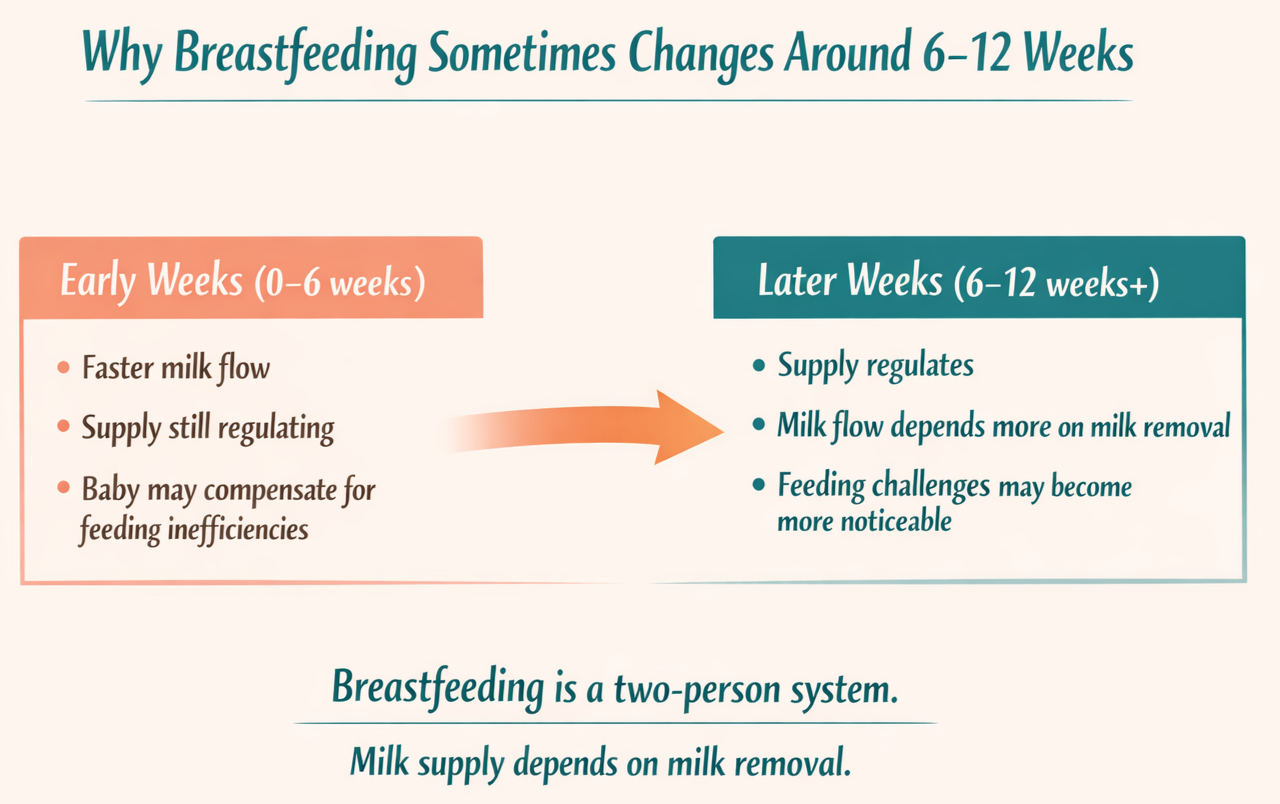
How Fast Milk Flow Can Mask Feeding Difficulties
When milk flows quickly, babies may not need to rely as much on suction and coordinated tongue movement to remove milk.
Instead, they may receive milk primarily from the natural flow of the breast.
This means that some feeding challenges may go unnoticed early on.
For example, a baby who struggles with suction may still get enough milk if the breast is releasing milk quickly.
Similarly, a baby with limited tongue movement may still transfer milk if the flow is strong enough.
When supply begins to regulate and milk flow slows slightly, these babies may suddenly have to work harder to remove milk.
This is when feeding difficulties sometimes become more noticeable.
Signs That Feeding Challenges May Be Emerging
When milk flow changes, parents may begin to notice subtle shifts in feeding patterns. These changes can include:
Longer feeding sessions
Baby becoming frustrated at the breast
More frequent feeding
Baby slipping off the breast more often
Increased clicking sounds during feeding
Baby appearing to work harder to maintain suction
Baby tiring quickly during feeds
Parents sometimes interpret these changes as a sudden drop in milk supply. In some cases, however, the underlying issue may be how effectively the baby is removing milk.
Why Babies Can Compensate Early On
Babies are remarkably adaptable.
If feeding mechanics are not working efficiently, many babies develop ways to compensate.
They may:
Feed more frequently
Stay at the breast longer
Use jaw compression instead of suction
Tire quickly and return to the breast sooner
When milk flow is fast, these strategies may still allow the baby to receive enough milk.
But as milk supply becomes more regulated and flow slows slightly, these compensations may become less effective.
Looking at the Whole Feeding System
When feeding patterns change weeks into breastfeeding, it can be helpful to consider not only milk production but also how milk is being transferred.
Breastfeeding works best when babies are able to:
Maintain suction during feeding
Coordinate tongue and jaw movement
Remove milk efficiently from the breast
When feeding mechanics improve, milk removal often improves as well. And when milk removal improves, the body receives stronger signals to continue producing milk.
A Reassuring Perspective for Parents
For many parents, feeding changes that appear weeks after birth can feel confusing or discouraging.
It is common to wonder whether milk supply has suddenly decreased or whether something has gone wrong.
In many cases, these changes are part of the natural shift that occurs when milk production becomes more regulated.
Sometimes this transition simply reveals feeding challenges that were harder to see in the early weeks.
Looking at both milk supply and milk transfer can help families better understand what may be happening and find ways to support feeding more effectively.
If you have questions if there is a sudden shift in feeding behavior, please reach out to schedule a feeding evaluation and make a plan that is most comfortable for your family.
Up Next in the Series
In the next article, we’ll look at signs that a baby may be affecting milk supply, and how to recognize subtle feeding patterns that can influence breastfeeding over time.
Part of the Series: The Other Side of Milk Supply
✔ Breastfeeding Is a Two-Person System
✔ When the Latch Looks Good but Milk Transfer Isn’t
✔ Why Fast Milk Flow Can Hide Feeding Challenges
⬜ Signs Your Baby May Be Affecting Milk Supply
⬜ How Improving Feeding Mechanics Can Support Supply